



In Brief:
Most brand promises and value propositions are designed around functional outcomes and category-level claims. This framework I created 15+ years ago was designed to uncover deeper levels of value, helping you craft highly relevant, differentiating propositions and brands.
Want to become chosen by more customers, more time?
Having helped craft closer to 1000 propositions for clients, I see the following issues over and over:
👉 most propositions focus mostly on functional outcomes
👉 most propositions are mere category promises, meaning they fail to provide relevance and differentiation, leading to lost choice
You get chosen only when customers see you as their most relevant choice.
And to become the most relevant choice, you have to start by understanding how specific customers judge value.
The good news is, there are many levels of value, and you are likely not leveraging them all.
In the video below, I explain how we build "demand models" for clients, and how we use a tool called Proposition Fit™ to diagnose and craft highly relevant propositions.
If you'd like to diagnose your brand promise or value proposition(s), I'll show you how to stop choice (=revenue) from leaking, and how to get chosen more.
—
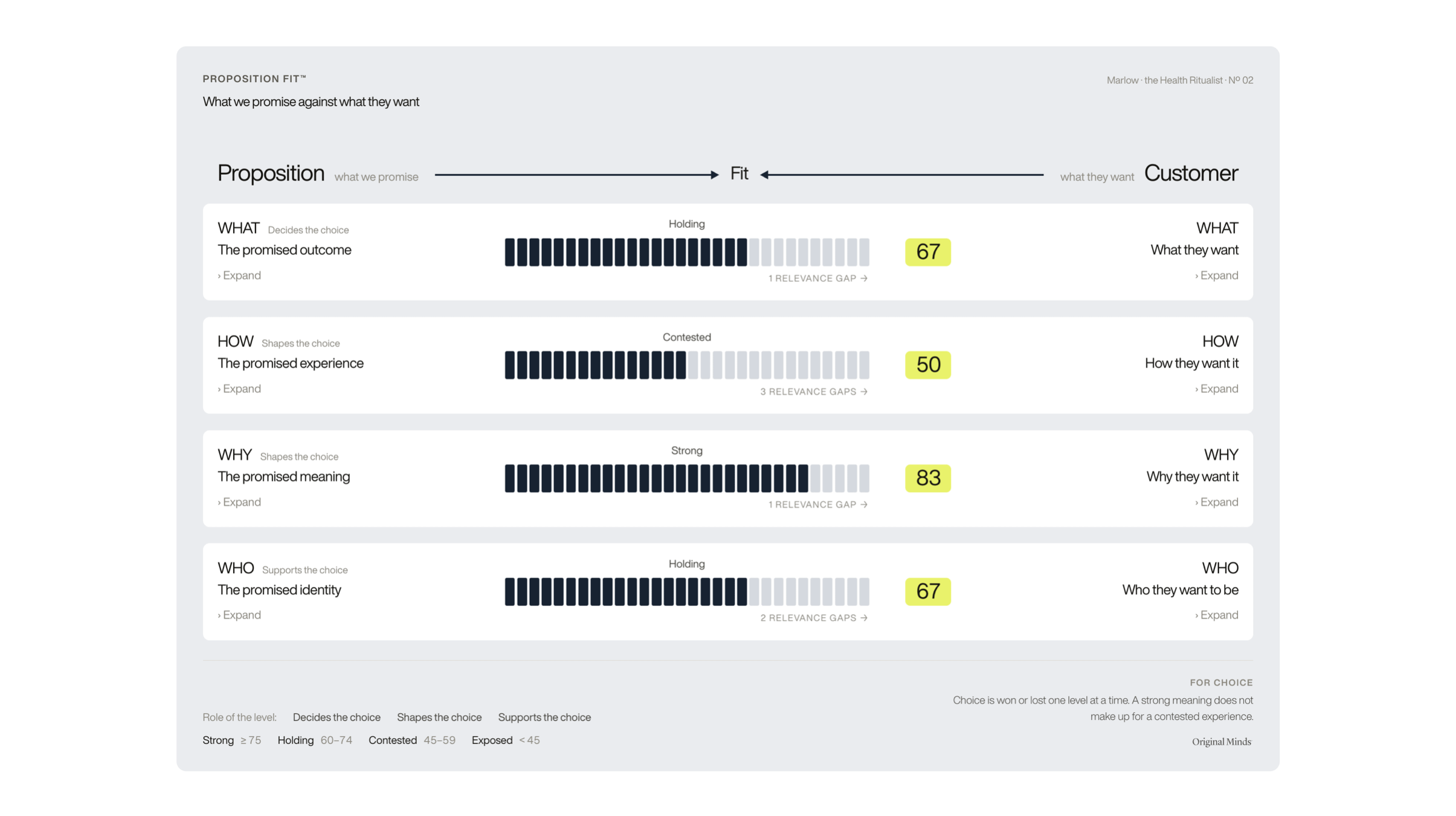
Proposition Fit™ - a model that measures how well what your offer vs. what they want.
You don’t get chosen for being different. You get chosen for being the most relevant option available to a specific person in a specific moment. Difference is comparative — it asks how you stack up. Relevance is intrinsic — it asks whether this is for me, given who I am and what I want.
A brand can be genuinely distinctive and still lose the decision, because the difference wasn’t one the customer cared about. And relevance is a match: what they want on one side, what you promise on the other. The closer those sit, the more obvious the choice feels.
When they drift apart, nothing dramatic happens. You stay in consideration. You get evaluated. You lose at the margin to someone whose promise fitted better. Nobody tells you — there’s no exit interview on a four-second decision. It surfaces months later as flat conversion, as campaigns that cost more for the same result, as a discount nobody planned to offer.
So where do propositions actually fall short?
Almost always in the same place. They answer one level of what the customer wants and leave three untouched.
Because customers don’t want one thing. They want four, and they’re weighing all of them at once.
What they want is the outcome — the job to be done. This is where nearly every proposition lives. It’s also where you and your competitors look most alike, because if you couldn’t do the job you wouldn’t be in the consideration set at all.
How they want it is the experience — what they’re trying to maximise and minimise on the way to that outcome. Netflix and Blockbuster offered the same what: a film tonight. Netflix won on how. Same job, completely different experience of getting there.
Why they want it is the meaning — the values and beliefs and higher-order outcomes sitting behind the job. This is where a proposition stops describing and starts mattering.
Who they want to be is the identity — who the customer is being when they choose, and who they’re moving toward. A great many purchases are identity decisions wearing functional clothing.
All four are present in every category. What changes is how much each one carries. In some decisions the outcome dominates. In others, particularly where the purchase is visible or carries real identity weight, meaning and identity decide more of it than any functional claim.
Which means the first strategic error is assuming you know which levels are doing the work in your category. Most companies don’t. They know which levels they’re good at, and the proposition was built around those.
This is what Proposition Fit™ measures.
On one side, what the segment wants at each of the four levels — built from evidence, and crucially, built before the brand is examined at all, so the model isn’t shaped by what anyone would like the answer to be.
On the other, what the proposition actually promises at those same four levels. Not what gets delivered — that’s a separate instrument. What is claimed, in words, in visuals, in price, in what the brand chooses to show.
Fit is how well the two match, level by level.
And the shape of the result is the finding, more than any single number. Strong on outcome, thin on meaning is the most common pattern we see. It means the brand is competing hardest where the differences between it and everyone else are smallest, while leaving the ground where preference and pricing power are built completely open.
That’s not a messaging problem. It’s a proposition that was never designed to answer three of the four questions.
A closing thought on why this is worth measuring rather than debating.
Most propositions are evaluated by the people who wrote them, against criteria they also chose. That process can produce something well-argued and still leave it answering a question customers aren’t asking. The only way out is to establish what the customer actually wants first, independently, and then read the promise against it.
Proposition Fit™ runs as one of four instruments inside the Relevance Diagnosis™ — a thirty-day read on why your ideal customers choose you, why they don’t, and what to close first.
If you’d like to see what yours looks like, that’s where to start: originalminds.co/diagnosis