



Attention grabbing. Different. Chosen?
In Brief:
In competitive markets, differentiation has become the default answer to a question it does not actually solve. The goal was never to be different. It was to be the most relevant choice — and that requires knowing, precisely, what your customers value and whether your proposition delivers it.
Walk into any strategy session in a crowded category and the conversation lands in the same place. “We need to differentiate”. “We look too similar to the competition”. “We need a clearer point of difference”. “What are we saying that is different?”
The questions are common. And poorly framed.
Because the problem is not that these brands are insufficiently different. It is that they are insufficiently relevant — to someone specific, on the dimensions that person actually uses to decide. Difference is comparative; it asks how you stack up against alternatives. Relevance is intrinsic; it asks whether this is for me, given who I am, what I want, how I want it, and why it matters.
A brand can be genuinely distinctive and still lose the decision, because the difference was not one the customer cared about. And a brand can be barely different at all and win consistently, because on the handful of dimensions that actually drive the choice, it is the best available answer.
Being chosen requires three things. Focus on customers specific enough to be understood. Understanding of how those customers judge value — better than your competitors understand it. And a proposition designed to signal and deliver that value across every dimension on which the decision is made.
Most companies do the first partially, the second superficially, and the third by accident.
Start with the second, because it is where the leverage sits.
Value is not a property of a product. It is a judgment made by a specific person weighing a specific decision, and that judgment is far more layered than most propositions account for. Customers are not running a feature comparison. They are assembling an answer to four questions simultaneously — usually without articulating any of them.
WHO — identity. Is this for someone like me? Does choosing it fit, or contradict, how I see myself and how I want to be seen? This dimension is almost never addressed explicitly and frequently decides the outcome.
WHAT — outcome. Does this deliver what I need it to deliver? The functional core. Necessary, rarely sufficient, and the dimension on which competitive differences are smallest.
HOW — experience. Is this easy, confident, low-friction? Does the way I get it and use it feel right? This is where preference forms and where most brands quietly lose customers they had already won.
WHY — meaning. Does this matter beyond its function? Does it connect to something I care about, stand for something, mean something? This is where premium pricing lives, and it is the dimension most propositions leave completely uncontested.
Together these form the 4D Value Stack — not a hierarchy of importance, but four distinct registers on which a proposition either lands or doesn’t. Their relative weight shifts by category, by segment, and by choice occasion. In some decisions WHAT dominates. In others, particularly where the purchase carries identity weight, WHO and WHY carry more of the outcome than any functional claim.
Which means the first strategic error most brands make is assuming they know which dimensions are doing the work in their category. Usually they don’t. They know which dimensions they are good at, and they have built the proposition around those.
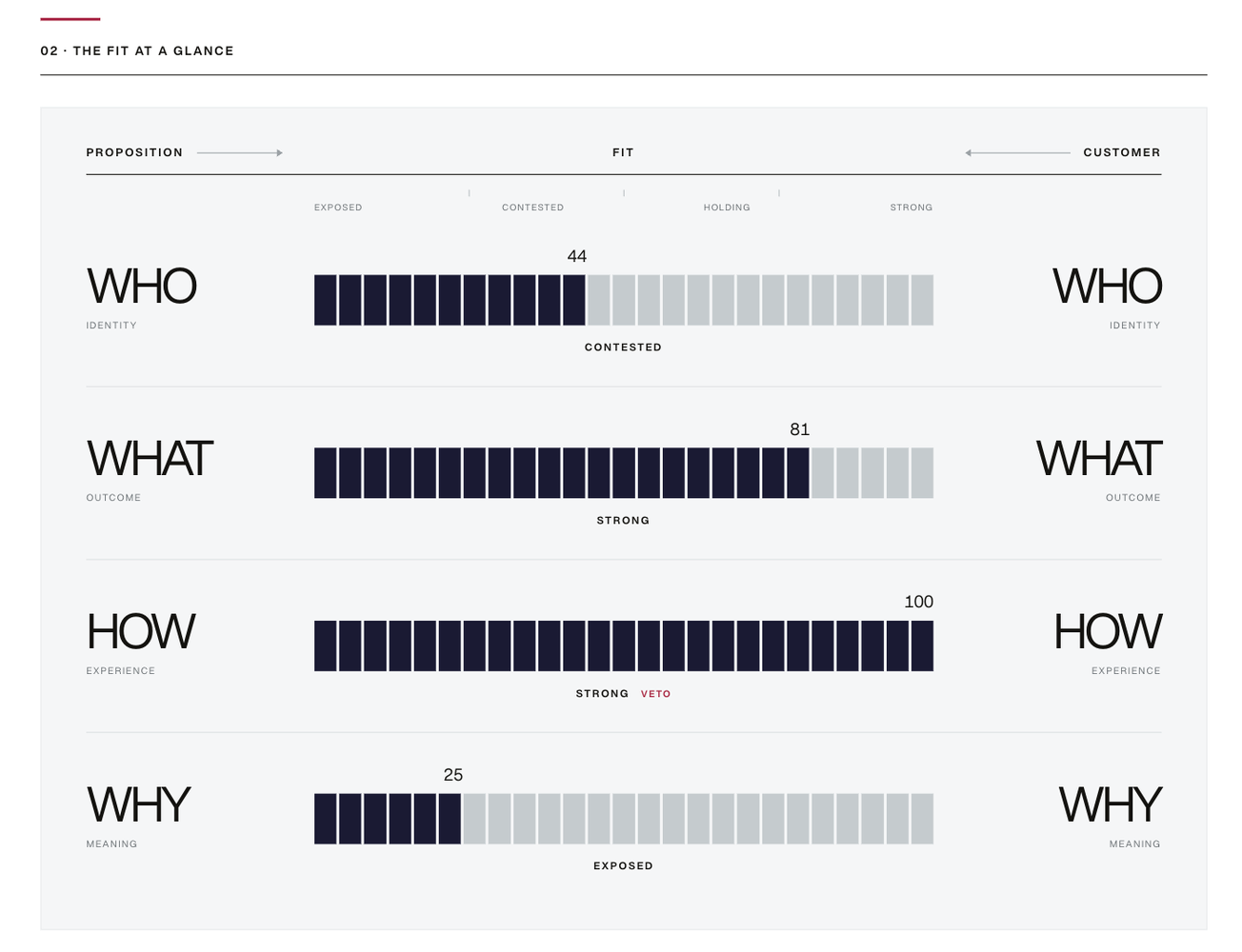
The tool I developed for this is what I call The Proposition Fit™, and it measures the distance between the two sides. I used this for 15+ years, but now with a little help from the machines, and a lot of help from smart strategists, it can be better standardized and measured. Which is what we do.
On one side, what the customer actually demands on each of the four dimensions — modelled brand-blind, weighted by importance, and frozen before the brand is examined at all. On the other, what the proposition actually signals and delivers. The gap between them, dimension by dimension, is the reading.
Each dimension resolves into one of four bands. Strong — the proposition meets or exceeds what the customer requires. Holding — adequate, but with no margin. Contested — a competitor is making a better claim on ground you need. Exposed — the customer weights this dimension heavily and your proposition has effectively nothing there.
The composite number matters less than the shape. A proposition scoring Strong on outcome, Contested on identity, and Exposed on meaning is telling you something precise: you are competing hard on the dimension where the differences are smallest, while leaving the dimensions where preference and pricing power are actually built completely open.
That shape is the most common one we find. It is also the most expensive.
The practical consequence of all of this is a different kind of proposition work.
Not finding a cleverer articulation of what you already do. But asking, against evidence rather than instinct: what do our highest-potential customers actually weight, in what proportion, and where does our proposition currently fail to meet it? Then designing against the answer — narrowing where narrowing earns relevance, building meaning where meaning is absent, fixing the experience that is quietly vetoing the choice before your positioning ever gets read.
This is different than a differentiation exercise and it produces something more durable. Because a proposition built to be different is competing on a claim. A proposition built to be relevant is competing on fit — and fit is much harder to copy, because it is specific to a customer your competitor has probably not bothered to understand as precisely.
You do not get chosen for being different. You get chosen for being the best available answer to a question the customer is asking in that moment.
Most brands have never established what the question is.
Proposition Fit™ is one of four instruments in the Relevance Diagnosis™ — a 30-day read on why your ideal customers choose you, why they don’t, and what to close first. Every gap named, evidenced, and carried to its commercial consequence. originalminds.co/diagnosis